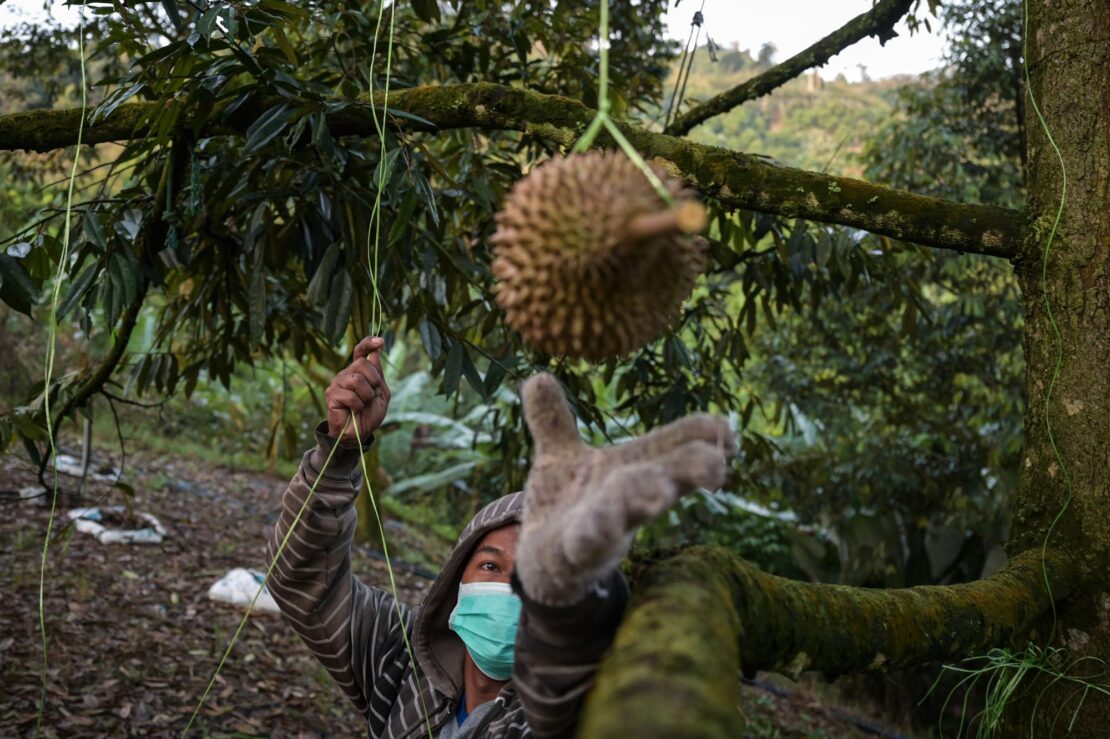
Battle for the Smelliest Fruit
A battle is unfolding over the world’s smelliest fruit, and farmers in Malaysia say their entire livelihood is being wiped out at the worst possible time
In Southeast Asia, the durian is the undisputed king of fruit. Crack open its thorny green husk, and you’ll find several yellow or red nuggets of custard-like pulp that melts in your mouth.
The smell, though, is divisive. Durians are so pungent that Anthony Bourdain once said they make your breath smell like “French-kissing your dead grandmother,” and food writer Richard Sterling opined that “its odour is best described as pig-s–t, turpentine, and onions, garnished with a gym sock.”
The fruit is so smelly it’s banned from public transport in Thailand, Japan, Singapore, and Hong Kong.
Still, durians are a special treat in Asian households, and, at as much as $13 a pound, they’re not cheap. They’re also the subject of an increasingly bitter year-long battle between Malaysian farmers who cultivate premium durian trees and a government-backed consortium that’s trying to cash in on the beloved fruit.
At the centre of this dispute is one specific breed of durian: the Musang King. It’s been called gold that grows on trees, and a single tree can earn farmers up to $1,000 a year.
Most of the world’s Musang King durians come from Raub, an old mining township of 100,000 people that has become the “durian capital of Malaysia” after farmers discovered its soil and climate were perfect for growing the fruit.